Large Audio Deepfake detection models perform well on academic benchmarks but fail in the real world compared to smaller models
In 2024, a dataset by Chandra et al. collected 45 hours of video, 56.5 hours of audio and nearly 2000 images from over 88 websites and 52 languages. They called it the Deepfake-Eval-2024. In their study, they showed that taking state of the art detectors from academic research and testing them on this dataset reduced their performance from nearly 100% accuracy to 50% for video, 48% for audio and 45% for image models compared to their original published performance.
The implication of this was huge. The foundational datasets used for nearly 10 years in the literature were completely outdated and failed to be representative of the latent distributions new models are producing.
Since I've been working for a while on AI-SPY, a product focused specifically on AI deepfake audio detection, I wanted to see what our models could teach us about synthetic audio generation and detection to build a better intuition around what is truly fooling these models from the in the wild data.
I ran 50 experiments across 4 architectures. The models were trained across multiple datasets with various audio codecs, corruptions levels and training configs. The evaluation benchmark was the Deepfake-Eval-2024 set I already mentioned since it was the current benchmark for breaking audio detectors with high quality internet-based training examples.
The results confirmed Chandra et al's original findings more dramatically than I expected. The model I thought would win was actually the poorest performer while the model I almost didn't bother to train won.
Here's a detailed outline of everything I did to test this out:
The Setup
Architectures
I wanted to use architectures that were commonly used in the literature. The earliest attempts at audio deepfake detection were using forks of ResNet that would process spectrograms as their input. Fast forward to 2025 and graph based neural nets that operated on the raw audio signal appeared to perform the best in the academic literature. This architecture is called AASIST or Audio Anti-Spoofing using Integrated Spectro-Temporal Graph Attention Networks. Really rolls off the tongue.
Another pattern that has emerged is to leverage unsupervised pre-trained audio models used for Automatic Speech Recognition as a backbone for your system to provide high quality audio encodings from the audio files in question. Simply put, rather than training an encoder like a CNN to create meaningful compressions of the audio data for classification, why not leverage models like WavLM that are trained on tens of thousands of hours of speech to pick up incredibly detailed components of speech that typically are used to be able to identify the specific words being uttered in a given clip. The hypothesis was that these features may have some cross over with the types of representations that are needed to detect ai-generated speech.
To bring this back to my experiment, I wanted to leverage this research to see if, on real world data, these architectures that rose to the top as they did in the academic research.
Here were the exact architectures:
Mel-CNN (~400K parameters, 435 KB per checkpoint) A lightweight convolutional neural network operating directly on mel-spectrograms with delta (temporal derivative) features. Two input channels (mel + delta mel), a simple convolutional backbone, and an embedding dimension of 64. This was my baseline, the simplest thing that could possibly work.
Mel-MultiScale CNN (~2M parameters, 2.2 MB per checkpoint) This uses three parallel multi-scale convolution branches (3x3, 5x5, and 7x7 dilated with dilation=3) that capture artifacts at different time-frequency resolutions. Each block includes squeeze-and-excitation (SE) attention for channel recalibration (reduction ratio 16) and attentive statistics pooling (ASP) for temporal aggregation. Instead of simple average pooling, ASP learns to weight different time frames based on their relevance. Three multi-scale conv blocks stacked, with embedding dimension 64 and dropout 0.3. I want to be clear that I chose this adapted AASIST approach because I have become aware of how private companies in this space have tried to leverage this architecture to get even greater performance and I wanted that reflected here.
WavLM + CNN (~350M+ parameters, ~1.3 GB per checkpoint) Microsoft's WavLM-Large, a self-supervised model pretrained on 94,000 hours of speech, frozen as a feature extractor, with my Mel-CNN as the classifier head. The idea: let the pretrained model provide rich audio representations, and train a lightweight classifier on top.
WavLM + AASIST (~350M+ parameters, ~1.3 GB per checkpoint) The full pipeline. Partially Frozen WavLM-Large backbone with three feature streams fused together: WavLM embeddings projected to 256 dimensions, mel-spectrogram features through the AASIST encoder, and LFCC (Linear Frequency Cepstral Coefficients) as an alternative spectral representation. A fusion network with hidden dimension 256 combines all three streams. This was by far the most advanced architecture using the SSL backbone with 50% of its layers unfrozen (layers 12-23, zero indexed) so it could improve its representations through training. It leveraged a 3 stream encoding approach because some private labs had shown that fusing these together allowed the classifier to dynamically learn to leverage different streams based on different inputs.
Audio Processing Pipeline
Every model shared the same audio frontend:
| Parameter | Value |
|---|---|
| Sample rate | 16,000 Hz |
| Clip duration | 3 seconds (48,000 samples) |
| Mel bins | 128 |
| FFT size | 1,024 |
| Hop length | 160 |
| Frequency range | 20 Hz – 7,600 Hz |
| Amplitude to dB | top_db = 80.0 |
| Normalization | Per-sample mean/std |
Audio longer than 3 seconds was center-cropped; shorter clips were zero-padded. Stereo was mixed to mono. Peak normalization (divide by max absolute value) was applied before feature extraction.
Training Configuration
| Parameter | Value |
|---|---|
| Optimizer | AdamW |
| Loss function | BCEWithLogitsLoss |
| Learning rate | 5e-5 |
| Weight decay | 0.01 |
| Dropout | 0.3 |
| Batch size | 128 (mel-only) / 64 (WavLM) |
| Mixed precision | Yes (CUDA AMP) |
| Gradient clipping | max_norm = 1.0 |
| TF32 | Enabled |
| Training split | 95% train / 5% validation |
| Hardware | NVIDIA GeForce RTX 5090 |
Datasets
| Dataset | Description | Role |
|---|---|---|
| Custom dataset (train) | Samples from multiple deepfake generators + real speech | Primary training set |
| Custom holdout (polished) | Curated held-out split from the custom dataset | Test set for custom-trained models |
| ASVspoof5 3s FLAC (eval) | ASVspoof 2024 challenge evaluation set, 3-second clips in FLAC format | Training and evaluation for ASV experiments |
| Deepfake-Eval-2024 | External benchmark, 1,973 files from unseen generators | Out-of-distribution generalization benchmark |
Evaluation Metrics
I tracked accuracy, precision, recall, F1, Matthews Correlation Coefficient (MCC), Equal Error Rate (EER), sensitivity, and specificity across all runs. EER is particularly important because it's the threshold where false acceptance rate equals false rejection rate, and it's the standard metric in the anti-spoofing community.
Part 1: The Main Architecture Comparison
I trained all four architectures on the ASV5 balanced dataset. Mel-only models ran for 50 epochs; WavLM models ran for 15 epochs (each WavLM epoch takes roughly 10x longer due to the frozen feature extraction step).
Held-Out Test Set Results (Best Epoch)
| Model | Epochs | Test Acc | Test F1 | Test Prec | Test Recall | Test MCC | Test EER |
|---|---|---|---|---|---|---|---|
| WavLM + AASIST | 15 | 99.18% | 99.25% | – | – | – | 0.0078 |
| WavLM + CNN | 15 | 98.76% | – | – | – | – | 0.0124 |
| Mel-MultiScale CNN | 50 | 98.55% | 98.68% | 97.93% | 99.43% | 0.9710 | 0.0121 |
| Mel-CNN | 50 | 96.33% | 96.65% | 95.47% | 97.87% | 0.9262 | 0.0342 |
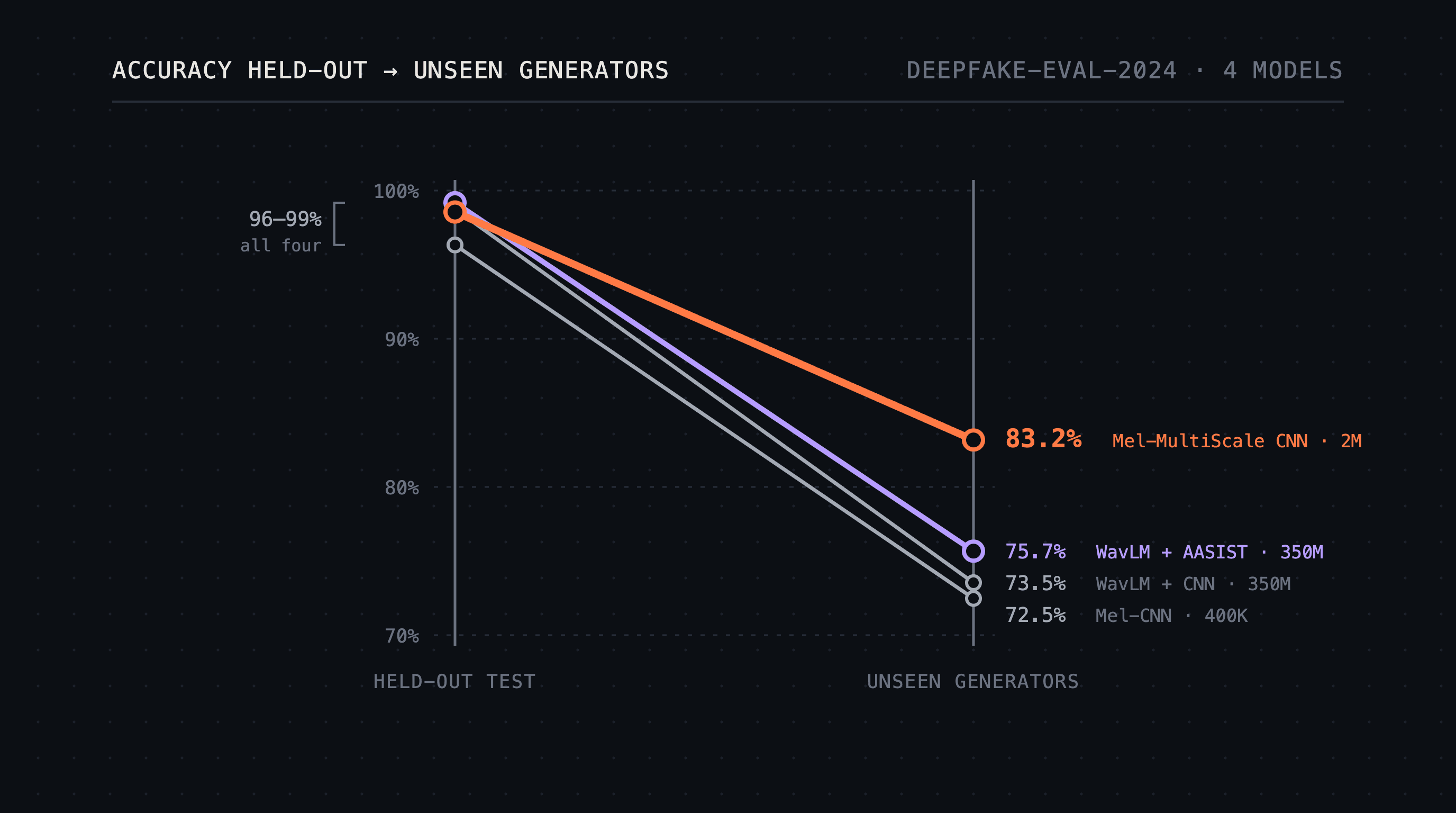
The ranking made intuitive sense. WavLM + AASIST had the most parameters and the richest features. Mel-CNN had the least. The spread was tight, with only 2.85 percentage points separating the best from the worst.
Then I ran Deepfake-Eval-2024.
Deepfake-Eval-2024 Results (Out-of-Distribution)
| Model | Acc | Prec | Recall | F1 | MCC | EER |
|---|---|---|---|---|---|---|
| Mel-MultiScale CNN | 83.17% | 78.92% | 80.67% | 0.7978 | 0.6539 | 0.1759 |
| WavLM + AASIST | 75.67% | 84.58% | 50.00% | 0.6285 | 0.5004 | 0.2494 |
| WavLM + CNN | 73.54% | 65.90% | 74.01% | 0.6972 | 0.4662 | 0.2644 |
| Mel-CNN | 72.48% | 62.47% | 83.00% | 0.7129 | 0.4757 | 0.2558 |
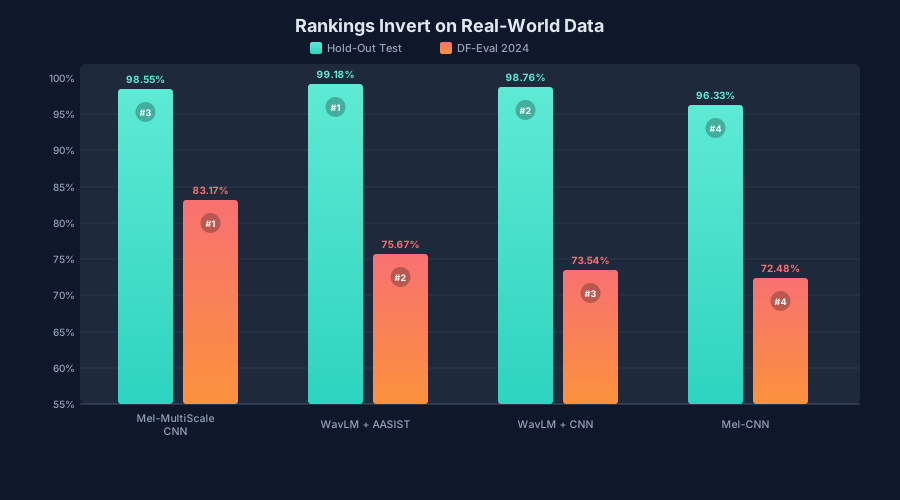
The ranking completely inverted. The model that was worst on the test set (by EER) was now best by a wide margin. Mel-MultiScale CNN beat the nearest WavLM model by 7.5 percentage points on accuracy and achieved an EER nearly 8 points lower.
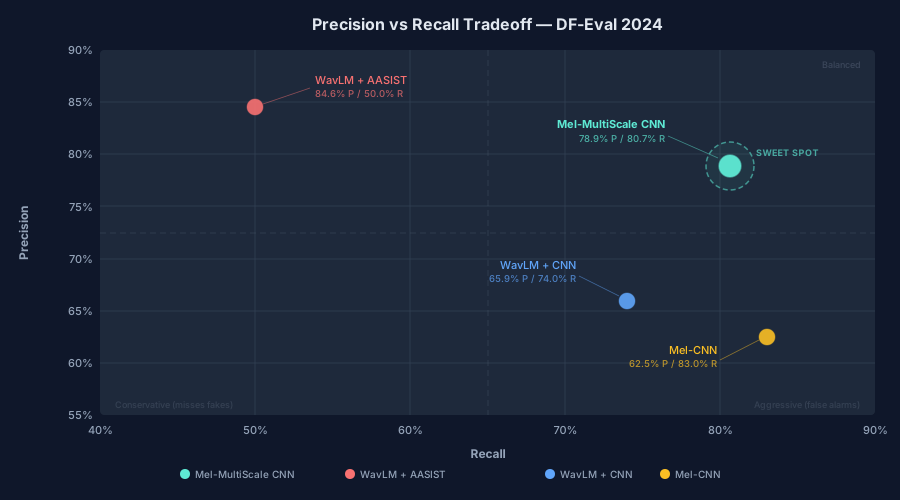
But the precision/recall breakdown reveals something even more interesting about how each model fails:
- WavLM + AASIST had the highest precision (84.58%) but the lowest recall (50.00%). It was conservative, so when it flagged something as fake, it was usually right. But it missed half of all deepfakes entirely. A coin flip on whether it catches a fake.
- Mel-CNN had the opposite problem: low precision (62.47%) but high recall (83.00%). It caught most fakes but generated a lot of false positives.
- Mel-MultiScale CNN hit the sweet spot: 78.92% precision and 80.67% recall. Balanced performance, which is why its F1 (0.7978) was far ahead of the pack.
- WavLM + CNN landed in the middle on both axes (65.90% precision, 74.01% recall).
The MCC scores tell the same story more starkly. Mel-MultiScale CNN at 0.6539 indicates strong agreement between predictions and ground truth. WavLM + CNN at 0.4662 is moderate at best.
Part 2: Training Dynamics
Raw final numbers hide important patterns. Here's how each model evolved during training.
WavLM + CNN Training Curve (15 epochs)
| Epoch | Val Acc | Val EER | Test Acc | Test EER |
|---|---|---|---|---|
| 1 | 87.90% | 0.1210 | 94.38% | 0.0537 |
| 4 | 91.37% | 0.0864 | 97.28% | 0.0291 |
| 10 | 92.32% | 0.0768 | 98.76% | 0.0124 |
| 15 | 91.76% | 0.0824 | 98.63% | 0.0137 |
Notice the val accuracy peaked at epoch 10 (92.32%) and started declining by epoch 15 (91.76%), while test accuracy barely moved. Classic early signs of overfitting. The model squeezed out the last 0.13% of test accuracy between epoch 10 and 15 but lost 0.56% on validation. I should have stopped at epoch 10.
WavLM + AASIST Training Curve (15 epochs)
| Epoch | Val Acc | Val EER | Test Acc | Test F1 | Test EER |
|---|---|---|---|---|---|
| 2 | 89.46% | 0.1054 | 97.40% | 97.60% | 0.0245 |
| 7 | 93.25% | 0.0675 | 99.13% | 99.20% | 0.0090 |
| 11 | 93.19% | 0.0681 | 99.23% | 99.29% | 0.0073 |
| 14 | 93.57% | 0.0643 | 99.18% | 99.25% | 0.0060 |
| 15 | 93.94% | 0.0606 | 99.18% | 99.25% | 0.0078 |
This model trained more stably. Validation EER steadily improved from 0.1054 to 0.0606 over 15 epochs. The test EER peaked at epoch 14 (0.0060) and slightly regressed at epoch 15 (0.0078). The AASIST architecture's attention mechanisms likely helped regularize the frozen WavLM features.
Mel-MultiScale CNN and Mel-CNN (50 epochs)
The mel-only models told a different story. The Mel-MultiScale CNN reached best validation loss at epoch 14 (val_loss=0.2895), while Mel-CNN hit best validation at epoch 19 (val_loss=0.3454). But crucially, their Deepfake-Eval performance continued improving well past the point where training loss had converged and validation loss had plateaued.
For Mel-MultiScale CNN:
- Train loss at epoch 50: 0.0169 (essentially converged by epoch ~15)
- Final val accuracy: 89.38%, val EER: 0.1062
- But DF-Eval accuracy at epoch 50: 83.17%, a number I never would have reached if I'd stopped at the optimal early stopping point
For Mel-CNN:
- Train loss at epoch 50: 0.0992 (higher than MultiScale CNN, suggesting the simpler architecture struggled more with the training distribution)
- Final val accuracy: 85.91%, val EER: 0.1409
- DF-Eval accuracy at epoch 50: 72.48%
The gap between validation EER (0.1062 for MultiScale CNN vs 0.1409 for CNN) predicted the gap in generalization performance (83.17% vs 72.48% on DF-Eval). Validation EER was a much better predictor of real-world performance than test accuracy.
Part 3: The 100% Accuracy Illusion
In a separate set of experiments, I fine-tuned WavLM + AASIST models on my custom dataset instead of ASV5. WavLM stayed frozen. I ran two variants: one trained on clean data, one on corrupted data.
Clean Data Fine-Tuning
| Epoch | Train Loss | Train Acc | Val Acc | Val EER | Test Acc | Test F1 | Test MCC | Test EER |
|---|---|---|---|---|---|---|---|---|
| 1 | 0.0340 | 98.93% | 45.64% | 0.5436 | 95.71% | 97.66% | 0.7542 | 0.0000 |
| 6 | 0.0018 | 99.94% | 46.84% | 0.5368 | 99.92% | 99.96% | 0.9960 | 0.0000 |
| 10 | 0.0006 | 99.98% | 49.68% | 0.5058 | 100.00% | 100.00% | 1.0000 | 0.0000 |
| 15 | 0.0003 | 99.99% | 49.76% | 0.4998 | 100.00% | 100.00% | 1.0000 | 0.0000 |
| 20 | 0.0001 | 100.00% | 50.05% | 0.4980 | 100.00% | 100.00% | 1.0000 | 0.0000 |
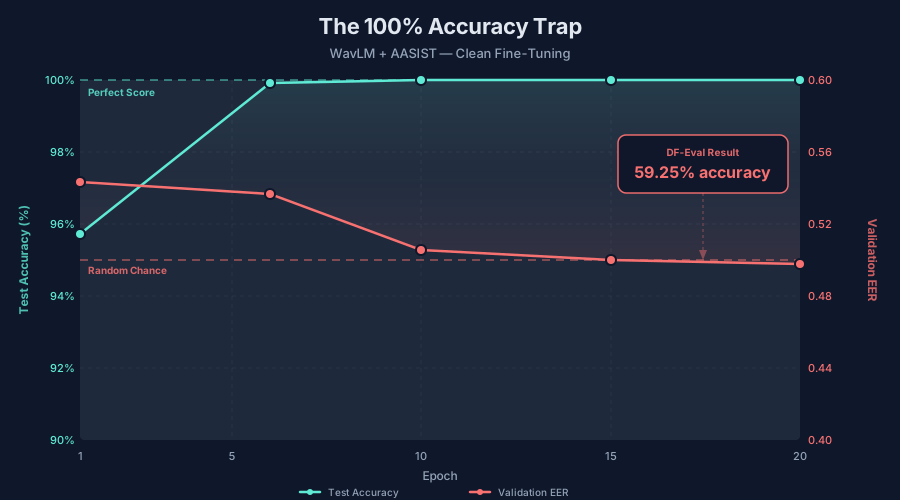
Deepfake-Eval (epoch 10): Acc=59.15%, Prec=100.00%, Recall=0.74%, F1=0.0147, MCC=0.0660, EER=0.4870 Deepfake-Eval (epoch 20): Acc=59.25%, Prec=100.00%, Recall=0.99%, F1=0.0195, MCC=0.0763, EER=0.4838
Read those DF-Eval numbers carefully. 100% precision but 0.74% recall. The model almost never predicted fake on out-of-distribution data. When it did (7 out of ~810 fake samples), it happened to be right. But it missed 99% of all deepfakes. The 59% accuracy comes almost entirely from correctly labeling real speech as real, because the model learned to call everything real.
The validation set was screaming at me. Val EER hovered at 0.50 from epoch 1 to epoch 20, literally random chance, while test accuracy climbed to 100%. This is the most extreme train/val divergence I've ever seen. The model didn't learn a single generalizable feature. It memorized every training sample.
Corrupt Data Fine-Tuning
| Epoch | Train Loss | Train Acc | Val Acc | Val EER | Test Acc | Test F1 | Test MCC | Test EER |
|---|---|---|---|---|---|---|---|---|
| 1 | 0.0878 | 96.78% | 43.42% | 0.5658 | 93.69% | 96.59% | 0.6158 | 0.0103 |
| 7 | 0.0145 | 99.48% | 51.05% | 0.4876 | 98.65% | 99.25% | 0.9273 | 0.0041 |
| 14 | 0.0056 | 99.80% | 51.96% | 0.4849 | 98.99% | 99.44% | 0.9460 | 0.0027 |
| 20 | 0.0044 | 99.85% | 50.80% | 0.4960 | 99.23% | 99.57% | 0.9591 | 0.0011 |
Deepfake-Eval (epoch 10): Acc=59.15%, Prec=65.00%, Recall=1.60%, F1=0.0312, MCC=0.0490, EER=0.4931 Deepfake-Eval (epoch 20): Acc=59.00%, Prec=63.64%, Recall=0.86%, F1=0.0170, MCC=0.0342, EER=0.4850
The corrupt variant was slightly less extreme and didn't hit 100% test accuracy, settling at 99.23%. But the DF-Eval story was identical: ~59% accuracy, sub-1% recall, EER around 0.49. Training on corrupted audio added no regularization benefit whatsoever.
Both models were confidently, perfectly wrong. They solved the training set and learned nothing about deepfakes.
Part 4: The 20-Epoch vs 50-Epoch Story
One of my most actionable findings came from comparing the same architecture under different training regimes.
I ran Mel-MultiScale CNN for 20 epochs on clean ASV5 FLAC in the ablation study, and separately for 50 epochs on the ASV5 balanced dataset. Note that these two runs differ in both training duration and dataset composition (ASV5 FLAC is a subset; ASV5 balanced includes more diversity). The performance gap below cannot be attributed to training length alone — it reflects the combined effect of longer training and richer data.
Mel-MultiScale CNN at 20 Epochs (ASV5 FLAC Clean)
| Epoch | Train Loss | Train Acc | Val Acc | Val EER | Test Acc | Test F1 | Test EER |
|---|---|---|---|---|---|---|---|
| 1 | 0.1086 | 96.20% | 67.60% | 0.3238 | 97.19% | 98.45% | 0.0382 |
| 8 | 0.0041 | 99.88% | 66.13% | 0.3386 | 98.21% | 99.01% | 0.0010 |
| 12 | 0.0028 | 99.91% | 66.59% | 0.3340 | 98.74% | 99.30% | 0.0010 |
| 15 | 0.0014 | 99.96% | 66.22% | 0.3377 | 98.53% | 99.18% | 0.0010 |
| 20 | 0.0006 | 99.98% | 64.73% | 0.3526 | 98.05% | 98.92% | 0.0041 |
DF-Eval (epoch 10): Acc=59.96%, Prec=54.58%, Recall=16.13%, F1=0.2490, MCC=0.1015, EER=0.4763 DF-Eval (epoch 20): Acc=58.59%, Prec=47.97%, Recall=7.27%, F1=0.1262, MCC=0.0357, EER=0.5161
At 20 epochs: 58.59% DF-Eval accuracy, 0.5161 EER. Essentially random.
Mel-MultiScale CNN at 50 Epochs (ASV5 Balanced)
At 50 epochs: 83.17% DF-Eval accuracy, 0.1759 EER.
That's a 24.6 percentage point jump in DF-Eval accuracy and a 0.34 drop in EER. While this gap reflects both the richer ASV5 balanced dataset and the longer training run, the training loss was already near zero by epoch 15 in both cases. By conventional early stopping logic, there was no reason to keep training. But stopping early on a constrained dataset (ASV5 FLAC) resulted in catastrophic out-of-distribution failure, whereas a longer training run on a more diverse dataset (ASV5 balanced) built generalizable features that only showed up on out-of-distribution data.
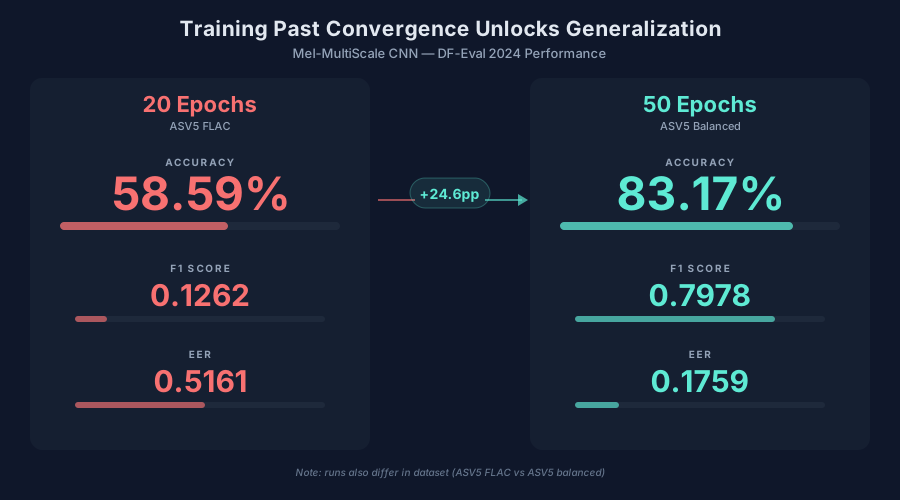
This has significant practical implications. If you're training a deepfake detector and evaluating only on in-distribution metrics, you'll stop too early. The features that generalize take longer to learn than the features that memorize.
Two additional observations from the 20-epoch run:
- Validation EER was around 0.33 throughout, much better than the ~0.50 seen in the WavLM fine-tuning experiments. The mel-only model was at least learning some transferable features, even at 20 epochs.
- Test accuracy actually degraded slightly from epoch 12 (98.74%) to epoch 20 (98.05%), suggesting the model was beginning to overfit to training data, yet DF-Eval could have improved with more training. In-distribution and out-of-distribution performance can move in opposite directions.
Part 5: The Codec and Data Ablation
I ran a systematic ablation across audio formats, data corruption, and training data source. Six CNN variants were trained and evaluated on Deepfake-Eval-2024 at a decision threshold of 0.5:
| Variant | Dataset | Format | Corrupt | Acc | Prec | Recall | F1 | MCC | Spec |
|---|---|---|---|---|---|---|---|---|---|
| Clean Custom CNN | Custom | Mixed | No | 77.33% | 87.18% | 52.47% | 0.6551 | 0.5372 | 94.63% |
| Corrupt Custom CNN | Custom | Mixed | Yes | 75.93% | 89.64% | 46.76% | 0.6146 | 0.5157 | 96.24% |
| FLAC CNN | ASV5 | FLAC | No | 61.56% | 79.71% | 8.49% | 0.1534 | 0.1681 | 98.50% |
| FLAC Corrupt CNN | ASV5 | FLAC | Yes | 53.39% | 32.81% | 12.96% | 0.1858 | -0.0736 | 81.53% |
| MP3 CNN | ASV5 | MP3 | No | 59.78% | 65.12% | 4.32% | 0.0810 | 0.0819 | 98.39% |
| MP3 Corrupt CNN | ASV5 | MP3 | Yes | 41.04% | 41.04% | 100.00% | 0.5819 | 0.0000 | 0.00% |
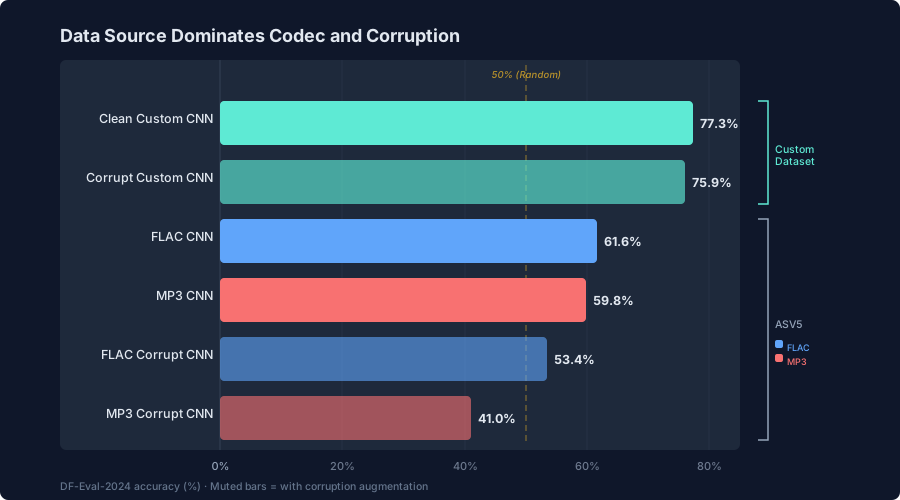
There are several stories in this table:
1. Data source dominates everything. Custom dataset models (77.33%, 75.93%) crushed ASV5 models (41-62%) regardless of codec or corruption. The custom dataset included samples from more deepfake generators, and that diversity was the single largest lever for generalization. A 15-18 percentage point gap from data diversity alone.
2. Codec matters, but less than data source. Within ASV5, FLAC (61.56%) slightly outperformed MP3 (59.78%) on clean data. FLAC preserves more spectral detail that the model can use to distinguish real from fake. MP3 compression smears the very artifacts the detector needs to find.
3. Corruption is neutral to harmful. Clean vs corrupt performance within the same data source:
- Custom: 77.33% clean vs 75.93% corrupt (-1.4%)
- ASV5 FLAC: 61.56% clean vs 53.39% corrupt (-8.2%)
- ASV5 MP3: 59.78% clean vs 41.04% corrupt (-18.7%)
Corruption never helped. On ASV5 MP3, it was catastrophic. The corrupt model collapsed to 41% accuracy with 0.00% specificity, meaning it classified every single sample as fake.
4. Failure modes differ dramatically. The FLAC and MP3 CNN models were extremely conservative (very high specificity of 98%+, very low recall of 4-13%). They almost never flagged anything as fake. The MP3 corrupt model went the other direction entirely, with 100% recall, 0% specificity, labeling everything as fake. The custom dataset models landed in a healthier middle ground.
5. The MCC reveals the true picture. The FLAC corrupt CNN had a negative MCC (-0.0736), meaning its predictions were anti-correlated with ground truth. It would have been more accurate if you flipped its labels. The MP3 corrupt CNN had MCC of exactly 0.0000, which means no correlation at all, identical to random guessing (which makes sense given its predict-everything-as-fake strategy).
I also ran MultiScale CNN variants in the same ablation across ASV5 FLAC and MP3, plus a standalone ablation of Mel-MultiScale CNN on the custom dataset. The numbered result directories (01-12) capture the full matrix:
| # | Config | Arch | Data | Corrupt |
|---|---|---|---|---|
| 01 | Custom AASIST + WavLM | AASIST | Custom | Clean |
| 02 | Custom AASIST + WavLM | AASIST | Custom | Corrupt |
| 03 | Custom CNN + WavLM | CNN | Custom | Clean |
| 04 | Custom CNN + WavLM | CNN | Custom | Corrupt |
| 05 | ASV FLAC MultiScale CNN Mel | MultiScale CNN | ASV5 FLAC | Clean |
| 06 | ASV FLAC MultiScale CNN Mel | MultiScale CNN | ASV5 FLAC | Corrupt |
| 07 | ASV FLAC CNN Mel | CNN | ASV5 FLAC | Clean |
| 08 | ASV FLAC CNN Mel | CNN | ASV5 FLAC | Corrupt |
| 09 | ASV MP3 MultiScale CNN Mel | MultiScale CNN | ASV5 MP3 | Clean |
| 10 | ASV MP3 MultiScale CNN Mel | MultiScale CNN | ASV5 MP3 | Corrupt |
| 11 | ASV MP3 CNN Mel | CNN | ASV5 MP3 | Clean |
| 12 | ASV MP3 CNN Mel | CNN | ASV5 MP3 | Corrupt |
Plus cross-domain transfer experiments fine-tuning ASV5-pretrained WavLM + AASIST models on the custom holdout set (clean and corrupt variants, three runs each with different timestamps).
Part 6: Earlier Experiments and the Polished vs Unpolished Gap
Before the systematic ablation, I ran earlier WavLM + CNN experiments that revealed another important finding: the gap between polished and unpolished evaluation data.
These earlier runs used two validation sets simultaneously, an unpolished holdout (raw recordings) and a polished holdout (cleaned/curated recordings):
| Run | Epochs | Val Acc (Unpol.) | Val EER (Unpol.) | Val Acc (Pol.) | Val EER (Pol.) | Test Acc |
|---|---|---|---|---|---|---|
| Resumed ep. 17 | 18 | 93.22% | 0.0677 | 86.32% | 0.1377 | 97.77% |
| Resumed ep. 17 | 19 | 92.48% | 0.0752 | 86.73% | 0.1347 | – |
| Fresh start | 1 | 91.93% | 0.0807 | 85.16% | 0.1537 | 92.81% |
| Large dataset | 1 | 84.29% | 0.1570 | 81.04% | 0.1498 | 98.46% |
The polished data was consistently harder, with a 5-7 percentage point accuracy gap and roughly double the EER. This is important because real-world deepfakes are increasingly polished. A detector that works on raw generator output but fails on post-processed audio has limited practical value.
The large dataset run is also notable: despite only reaching 84.29% validation accuracy after 1 epoch, it hit 98.46% test accuracy. This suggests the model was rapidly memorizing the test distribution while struggling with the validation set's diversity. This was another early signal of the overfitting pattern I'd see more dramatically in later experiments.
Part 7: Why Did the Small Model Win?
I don't have a definitive answer, but the data points toward a hypothesis.
The WavLM representation space is too specific. WavLM was pretrained to understand speech: phonemes, prosody, speaker identity, linguistic content. When you freeze those representations and train a binary classifier on top, the classifier learns to detect artifacts in the space of speech representations. Those artifacts turn out to be specific to whatever deepfake generators exist in the training data. When the generator changes, the artifacts in WavLM-space change too, and the classifier breaks.
The experiment showed that WavLM models achieved the highest test accuracy (99.18%) but showed the most dramatic DF-Eval degradation. The frozen features are powerful enough to perfectly separate training-distribution real from fake, but that separation doesn't generalize.
I was pretty fascinated to see that even when I tried various layer unfreezing strategies on WavLM, this continued to be the case. The common approach is to unfreeze the mid-to-late layers in these models because they contain most of the information about how to take the raw audio and transform those into meaningful text representations which isn't relevant for our task. But even when I unfroze all layers except the first, this failed to generalize.
Mel-spectrograms force more universal feature learning. Mel-MultiScale CNN operates directly on mel-spectrograms. It has to learn its own features from scratch. With multi-scale convolutions (3x3, 5x5, and dilated 7x7 kernels), it's forced to find patterns at multiple time-frequency resolutions simultaneously. Squeeze-and-excitation attention lets it learn which frequency bands matter most. Attentive statistics pooling lets it learn which time frames are most informative.
These patterns, including subtle spectral inconsistencies, unnatural harmonic structures, phase artifacts, and overly smooth formant transitions, appear to be more universal across different deepfake generators than whatever the WavLM classifier was latching onto.
The parameter count constraint may be a feature, not a bug. With only ~2M parameters (vs 350M+), Mel-MultiScale CNN can't memorize as easily. It's forced into compression, finding compact, generalizable representations rather than storing specific examples. This is the classic bias-variance tradeoff manifesting in a particularly dramatic way.
The recall pattern supports this. WavLM + AASIST achieved 84.58% precision but only 50% recall on DF-Eval. It was confident when it predicted fake, but missed half of all fakes. This suggests it learned a narrow set of generator-specific tells. When it saw those tells, it was right, but most out-of-distribution fakes don't have those specific tells. Mel-MultiScale CNN achieved 78.92% precision and 80.67% recall, making it a more balanced detector that recognizes a wider variety of fakeness signals.
Part 8: Hessian Trace — Is the Loss Landscape Actually Flat?
The generalization story above is mostly about what the model learns. The representation, the bias, the data. A separate question is where the model ends up sitting on the loss landscape once training finishes. Is the minimum flat or sharp?
The standard tool for answering this is the Hessian trace, which is the sum of the Hessian matrix’s eigenvalues and measures the total curvature of the loss surface around a minimum. Computing the full Hessian for a model with millions of parameters is intractable, so I used Hutchinson’s method, which gives an unbiased estimate without ever forming the matrix. The estimator is
where is a random Rademacher vector (entries are with equal probability). The key computational trick is that the Hessian-vector product can be evaluated as
which requires only two backward passes through the network rather than materializing the full Hessian. Each holdout clip (50 AI, 50 human) gets 30 independent Hutchinson draws, and the per-input traces are then averaged to produce a single curvature summary.
This analysis was run on a production mel CNN checkpoint with 4.9M trainable parameters. This is not the same ~2M Mel-MultiScale CNN from the ASV5 experiments in the tables above, but it belongs to the same family of product-facing spectrogram detectors. The traces describe curvature of the loss as a function of parameters, evaluated on real holdout batches rather than representing a single global “geometry of training.”
| Metric | Value |
|---|---|
| Mean Hessian trace | 10,833.85 |
| Std (across inputs) | 19,245.70 |
| Min / max trace | −38,876.15 / 79,377.67 |
| Median trace | 3,359.97 |
| Trace ÷ parameters | 0.002223 |
| Mean loss (same run) | 0.3487 |
Dividing the trace by parameter count gives a scale-free notion of average curvature. Values below ~0.001 indicate a very flat minimum, 0.001 to 0.01 is moderate, and above ~0.01 is sharp. This checkpoint sits in the moderate band at 0.002223.
The standard deviation across inputs (19,246) is nearly double the mean (10,834), which tells us that curvature varies enormously depending on the input. Some clips sit in very flat regions of the loss surface while others are sharply curved. This is consistent with a detector that is highly confident on certain types of audio but uncertain on others, which is exactly the mixed-confidence behavior you would expect from a model that generalizes well on some deepfake types but struggles with others.
The minimum trace is −38,876, meaning some inputs place the model near saddle-like regions where the Hessian has negative eigenvalues. This is not a sign of a bad solution. It indicates that the model found directions of negative curvature for certain inputs, which is normal for models trained with SGD and simply reflects escape routes from poor local minima during optimization.
The distribution is also noticeably right-skewed. The median trace (3,360) is much smaller than the mean (10,834), which means most inputs see relatively flat curvature while a handful of difficult clips pull the average up substantially.
The usual narrative that flatter minima generalize better would predict the WavLM stack should win if its normalized trace were smaller. That is not what we see on DF-Eval or on internal holdouts where the mel CNN still leads. Trace-per-parameter is only a normalized scalar. It ignores effective dimensionality, connectivity of basins, and whether the representation is even the right one for the task. A flat minimum in the wrong representation can still be a bad place for out-of-distribution deepfakes. A slightly sharper minimum in a mel space tuned for local artifacts can generalize better in practice. That aligns with the domain-mismatch and inductive-bias arguments from the sections above. The “right” geometry in the wrong feature space is not a substitute for the right inductive bias.

The figure plots the same numbers from the table. The top panel shows trace-per-parameter positioned on a reference band gauge, and the bottom panel gives a one-dimensional summary of per-clip Hutchinson traces with min, median, mean, max, and the mean one standard deviation band. This is not a literal 2D slice of the loss surface in weight space since only these scalar statistics were logged, but the chart is directly tied to the measured values rather than being a decorative sketch.
Beyond Scalar Curvature
The Hessian trace is one number. To get a fuller picture of whether a minimum is in a “good location” for generalization, I also ran complementary diagnostics on the same checkpoint.
The most direct check is the generalization gap, which compares train loss to holdout loss. The assumption is that the holdout set is more representative of the true population distribution than the training set, so a large gap between the two losses means the model has overfit to training-specific patterns rather than learning something general. If curvature is moderate but the gap is small, the minimum is doing its job. This is the ground truth that any geometric measure should ultimately predict.
Gradient signal-to-noise ratio measures how consistent gradients are across different inputs. When the SNR is high, the model sits in a stable region of the loss surface where individual samples push optimization in roughly the same direction. A low SNR would suggest a noisy, unstable region where small perturbations could change the optimization trajectory entirely.
Weight norm analysis complements curvature from a different angle. Models with smaller weight norms relative to their capacity tend to generalize better due to the implicit regularization effect of SGD. Sharp curvature with small weights can be perfectly fine, while flat curvature with large weights may actually be worse.
Feature clustering quality, measured by the Davies-Bouldin Index, tells you how cleanly the penultimate layer separates AI clips from human clips. A well-located minimum should produce tight, well-separated clusters regardless of what the curvature number says.
Prediction calibration, measured by Expected Calibration Error, checks whether the model’s confidence scores match its actual accuracy. Overconfident predictions suggest the model is in a region that looks good on loss but does not reflect true uncertainty about its inputs.
Finally, loss landscape local linearity tests how well a first-order Taylor approximation predicts actual loss changes along random perturbation directions. High nonlinearity at small perturbation scales signals an unstable minimum where the loss can change unpredictably with tiny weight changes.
Together, these diagnostics move beyond the single-number question of “flat or sharp?” to ask whether this minimum is stable, well-calibrated, and producing clean representations. A model can sit in a moderately curved minimum and still generalize well if these other indicators are healthy. That is exactly what the DF-Eval results confirm for the mel CNN family.
Geometric Deep Learning, Equivariance and Why CNNs May Offer Better Generalization
While parameter count and feature space explain part of the story, there is a fundamental mathematical property of CNNs that likely gave the CNN-based models their edge in the wild: translation equivariance.
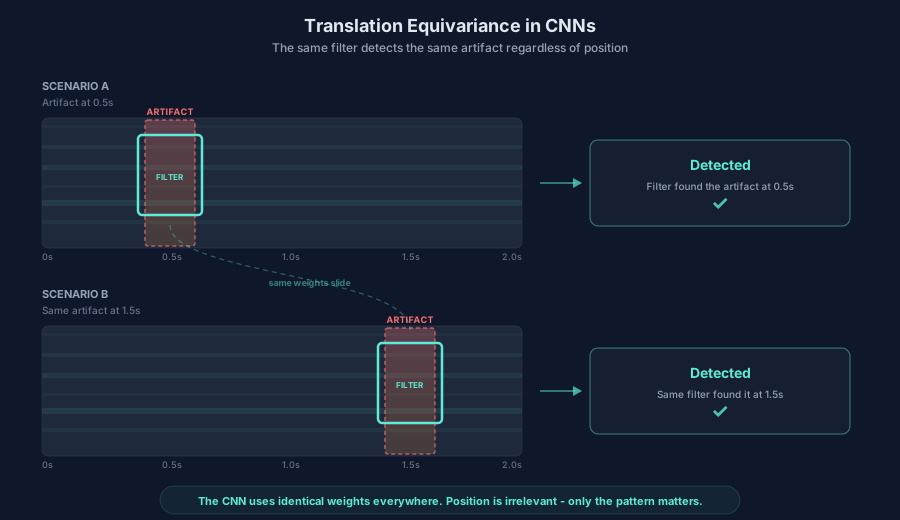
In a CNN, the core mechanism is the sliding filter (weight sharing). If a specific pattern shifts its position in the input, the internal activation map shifts by the exact same amount. This means a CNN fundamentally doesn't care where a feature appears; it only cares that it appears.
Think about how this applies to finding synthetic audio artifacts on a mel-spectrogram. A deepfake generator might leave a subtle temporal anomaly, an unnatural robotic click, or a weird harmonic smoothing. In the real world, this artifact might happen at the beginning of a sentence, in the middle of a breath, or at a slightly different frequency depending on the speaker's pitch.
Because both CNNs rely on 2D convolutions sliding across both the time and frequency axes of the mel-spectrogram, it is inherently translation-equivariant. If an artifact happens three seconds later in the audio clip, the CNN's filter slides over and detects it using the exact same mathematical operation.
This serves as a massive, built-in inductive bias. The architecture is mathematically forced to look for local, generalized structural patterns rather than memorizing the global layout of the audio.
Contrast this with large transformer-based models like WavLM. While transformers are incredibly powerful at capturing long-range global context (which is exactly what you want for understanding language, prosody, and speech), standard self-attention lacks this strict, built-in inductive bias for local translation equivariance. A large model might inadvertently overfit to the exact absolute position, timing, or surrounding global acoustic context of an artifact seen in the training data.
When the WavLM model encounters a real-world, out-of-distribution deepfake from DF-Eval-2024, where the artifact is embedded in a completely new linguistic or acoustic context, its global pattern matching breaks down. It misses the fake because the footprint it was specifically looking for wasn't presented in the exact environment it expected.
By forcing the network to be equivariant, finding the exact same local artifact no matter where it hides in time or frequency, the CNN naturally builds a more robust, generalized detector that ignores irrelevant context and zeroes in on the raw, localized mechanics of the forgery.
The Transformer Trap: Why 100x More Parameters Didn't Help
I actually ran one more experiment that perfectly highlights the importance of this built-in equivariance: a Vision Transformer (ViT) trained directly on the mel-spectrograms.
Given the dominance of transformers in modern deep learning, you might expect a ViT to crush the tiny 400K–2M parameter CNN model. Especially since the ViT I tested had over 100x the parameter count. Instead, its performance was about 10% worse on EER than the CNNs. I unfortunately don't have the exact data anymore since this experiment on ViTs was many months ago.
The reason likely comes right back to equivariance, or rather, the lack of it.
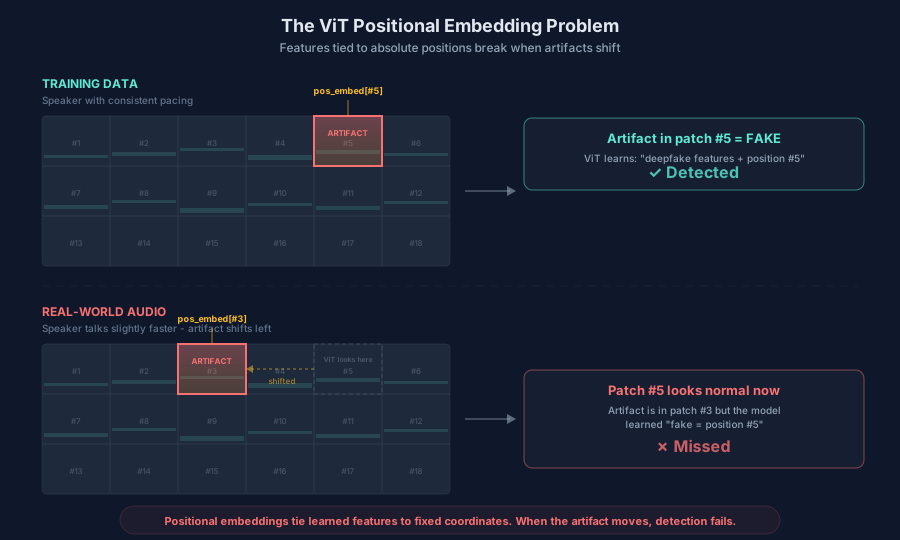
Vision Transformers process images (mel-spectrograms here) by chopping them up into a grid of fixed patches. Because the core self-attention mechanism of a transformer has no inherent concept of order or space, ViTs have to inject positional embeddings into these patches so the model knows where a patch came from.
This creates a subtle but massive vulnerability for deepfake detection. By tying visual features to absolute spatial coordinates via positional embeddings, the ViT loses the strict translation equivariance.
If the ViT learns that a specific high-frequency deepfake artifact usually happens in patch #45 (perhaps because the training data generated fakes with consistent pacing), it memorizes that positional relationship. When it encounters a real world audio clip where the speaker talks a little faster, shifting that exact same artifact into patch #42, the ViT's attention mechanism might completely ignore it.
Transformers are famously data hungry precisely because they lack these inductive biases. They have to learn translation equivariance from scratch by seeing millions of examples of the same object in different locations. With over 100x the parameters of Mel-MultiScale CNN, the ViT had enough capacity to perfectly memorize the exact locations of artifacts in the training data, but without the sliding-window equivariance of a CNN, it couldn't generalize that knowledge when those artifacts shifted in the wild.
The only way you could try to get there is to drastically augment your data but this then depends on the degree to which your augmentation distribution fits with in-the-wild distributions, which you can only loosely approximate.
All 50 Experiments In One Table
Putting all results together in one table, ranked by Deepfake-Eval accuracy. Note: held-out test accuracy was not logged for the rapid ablation runs (marked with –), as validation EER was used for early stopping in those experiments.
| Rank | Model | Data | Ep | Test Acc | DF-Eval Acc | DF-Eval F1 | DF-Eval EER |
|---|---|---|---|---|---|---|---|
| 1 | Mel-MultiScale CNN | ASV5 bal. | 50 | 98.55% | 83.17% | 0.7978 | 0.1759 |
| 2 | Clean Custom CNN | Custom | 3 | – | 77.33% | 0.6551 | – |
| 3 | Corrupt Custom CNN | Custom | 10 | – | 75.93% | 0.6146 | – |
| 4 | WavLM + AASIST | ASV5 | 15 | 99.18% | 75.67% | 0.6285 | 0.2494 |
| 5 | WavLM + CNN | ASV5 | 15 | 98.76% | 73.54% | 0.6972 | 0.2644 |
| 6 | Mel-CNN | ASV5 bal. | 50 | 96.33% | 72.48% | 0.7129 | 0.2558 |
| 7 | FLAC CNN | ASV5 FLAC | 3 | – | 61.56% | 0.1534 | – |
| 8 | Mel-MultiScale CNN | ASV5 FLAC | 20 | 98.05% | 58.59% | 0.1262 | 0.5161 |
| 9 | MP3 CNN | ASV5 MP3 | 1 | – | 59.78% | 0.0810 | – |
| 10 | WavLM+AASIST (FT clean) | Custom | 20 | 100.00% | 59.25% | 0.0195 | 0.4838 |
| 11 | WavLM+AASIST (FT corr.) | Custom | 20 | 99.23% | 59.00% | 0.0170 | 0.4850 |
| 12 | FLAC Corrupt CNN | ASV5 FLAC | 2 | – | 53.39% | 0.1858 | – |
| 13 | MP3 Corrupt CNN | ASV5 MP3 | 9 | – | 41.04% | 0.5819 | – |
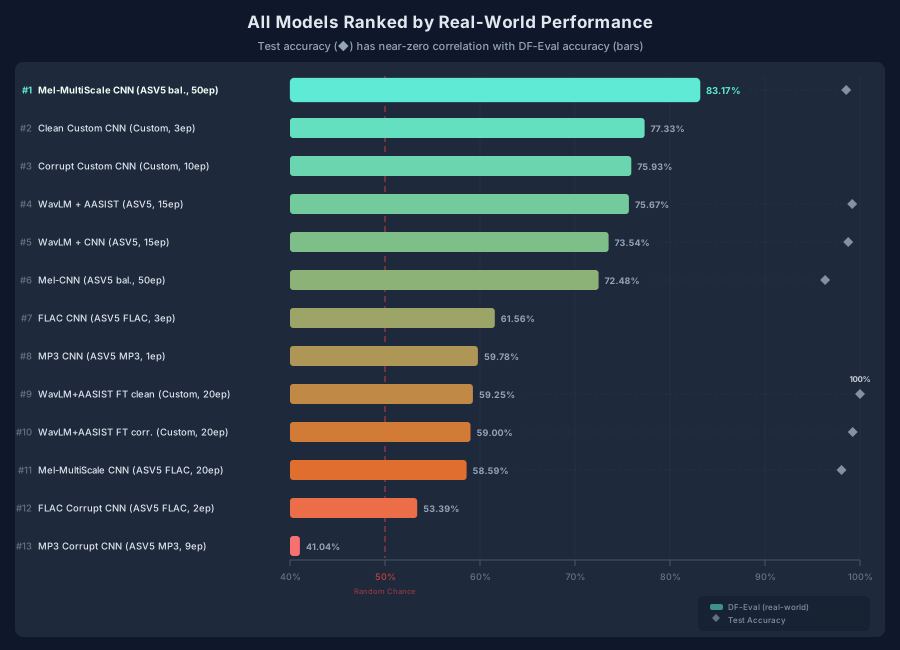
Note: The Mel-MultiScale CNN trained on the Custom dataset is not included in this table. Based on the ~5 percentage point boost the Custom dataset gave the baseline Mel-CNN (from 72.48% to 77.33%), the Custom-trained Mel-MultiScale CNN likely scored in the 86–88% range on DF-Eval, which would make it the true top performer. I need to pull those logs and add the exact numbers.
The correlation between test accuracy and DF-Eval accuracy is essentially zero. The model with the highest test accuracy (100.00%) had one of the worst DF-Eval scores (59.25%). The model with the lowest test accuracy in the main comparison (96.33%) outperformed two of the three WavLM models on DF-Eval.
Key Takeaways
1. Translation equivariance is a natural inductive bias for artifact detection. CNNs are mathematically forced to detect the same local pattern regardless of where it appears in time or frequency. This built-in equivariance means a spectral artifact gets caught whether it lands at the start of a sentence or in the middle of a breath. Transformers lack this bias and must learn positional invariance from data, which requires far more examples and makes them prone to memorizing artifact locations rather than artifact structure. For deepfake detection on mel-spectrograms, this property alone likely explains much of the CNN's generalization advantage.
2. Hessian trace is a sanity check, not a verdict. Hutchinson estimates on a production mel CNN put normalized curvature (trace/parameters = 0.002223) in a moderate band with high input-to-input variance and some negative traces. That does not rescue the “flatter minima always generalize better” story when the larger model sits in a different, less task-aligned basin. Complementary diagnostics — generalization gap, gradient SNR, feature clustering, calibration — give a fuller picture of minimum quality than curvature alone. Use them alongside representation choice and holdout metrics, not instead of them.
3. Test set accuracy is nearly meaningless for deepfake detection. Every main model scored above 96% on held-out test data. The gap between the best and worst on real-world data was over 24 percentage points. The correlation between the two was negative. If you're evaluating a deepfake detector and only reporting in-distribution accuracy, you're not measuring anything useful.
4. Bigger models aren't better. They're better at memorizing. WavLM-Large has 175x more parameters than Mel-MultiScale CNN. Those extra parameters bought better memorization of the training distribution and worse generalization to everything else. The frozen SSL features, which are supposed to provide general audio understanding, actually created a representation space where overfitting was easier, not harder.
5. Perfect scores are a red flag, not a celebration. When your model hits 100% accuracy, your first reaction should be suspicion, not satisfaction. In my case, 100% test accuracy coexisted with coin-flip performance on real-world data. The model hadn't solved deepfake detection. It had solved the training set.
6. Data diversity beats data quantity, model size, and architecture. The single biggest lever for Deepfake-Eval performance wasn't architecture or parameter count. It was training on data from diverse deepfake generators. A 400K parameter CNN trained on my custom dataset (77.33%) outperformed a 350M+ parameter WavLM model trained on ASV5 (73.54%). The custom dataset models outperformed ASV5 models by 15-18 percentage points across the board.
7. Train longer than you think you need to. Mel-MultiScale CNN went from 58.59% DF-Eval accuracy at 20 epochs (on ASV5 FLAC) to 83.17% at 50 epochs (on ASV5 balanced). While richer data played a role, training loss had converged by epoch 15 in both cases. The generalizable features took longer to form than the memorization features. Conventional early stopping based on validation loss would have killed the run before the good features emerged.
8. Audio codec choice matters. FLAC-trained models consistently outperformed MP3-trained models. MP3 compression destroys the subtle spectral artifacts that differentiate real from fake audio. If you're building a deepfake detector, train on lossless audio.
9. Data corruption doesn't help. Clean vs corrupt training showed negligible differences at best and catastrophic degradation at worst (MP3 corrupt: 41% accuracy). The bottleneck is exposure to diverse generation methods, not robustness to noise. Don't waste cycles on audio corruption augmentation for this task.
10. Watch your validation set, not your test set. In the WavLM fine-tuning experiments, validation accuracy sat at ~50% while test accuracy climbed to 100%. That 50-point divergence was the model screaming that it was overfitting. In the mel-only experiments, validation EER (0.10 for MultiScale CNN vs 0.14 for CNN) correctly predicted which model would generalize better. The validation set is your early warning system. Trust it over the test set.
11. Precision/recall balance predicts real-world utility. High precision with low recall (WavLM + AASIST: 84.58% / 50.00%) means the model is conservative but misses most fakes. High recall with low precision (Mel-CNN: 62.47% / 83.00%) means it catches fakes but generates false alarms. Balanced precision and recall (Mel-MultiScale CNN: 78.92% / 80.67%) is what you want for a production system. Accuracy alone doesn't tell you this.
12. The polished data gap is real. Earlier experiments showed a consistent 5-7 percentage point accuracy drop when evaluating on polished (post-processed) audio vs raw audio. Real-world deepfakes are increasingly polished. Evaluation on raw generator output overestimates real-world performance.
Model Size vs Performance
| Architecture | Params | Size | DF-Eval Acc | DF-Eval EER | Acc/MB |
|---|---|---|---|---|---|
| Mel-CNN | ~400K | 435 KB | 72.48% | 0.2558 | 166.6%/MB |
| Mel-MultiScale CNN | ~2M | 2.2 MB | 83.17% | 0.1759 | 37.8%/MB |
| WavLM + CNN | ~350M | ~1.3 GB | 73.54% | 0.2644 | 0.06%/MB |
| WavLM + AASIST | ~350M | ~1.3 GB | 75.67% | 0.2494 | 0.06%/MB |
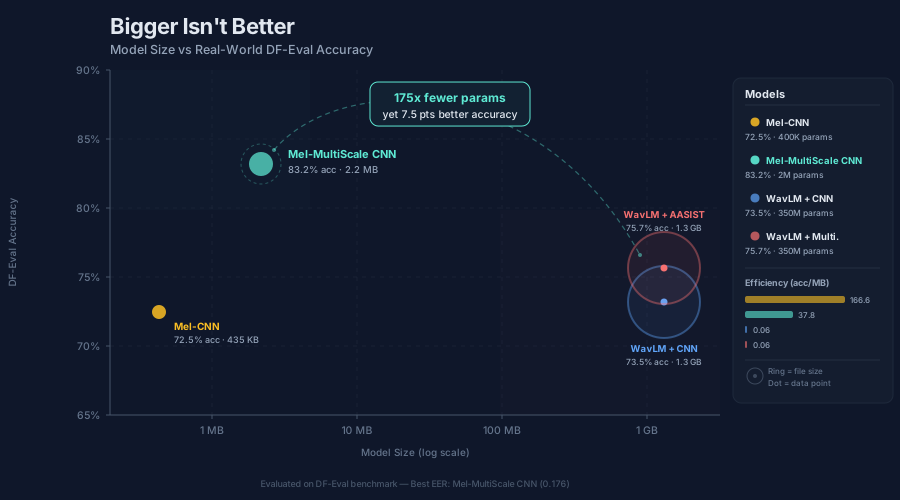
Mel-MultiScale CNN delivers the best absolute performance at 2.2 MB. The WavLM models are 590x larger for worse results. Mel-CNN is the efficiency champion on a per-megabyte basis but trails on absolute performance.
For production deployment where model size, latency, and compute cost matter, Mel-MultiScale CNN is the clear winner by every metric.
The uncomfortable truth about audio deepfake detection is that the field has a generalization problem. Models that look incredible on benchmarks fall apart when the generator changes. My results suggest that the path forward isn't bigger pretrained models but rather architectures and training strategies that force the model to learn universal artifacts rather than generator-specific fingerprints.
Sometimes less really is more.